

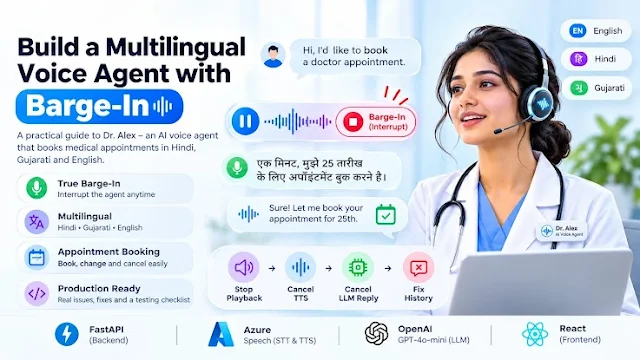
Voice Agent Barge-In: Hindi, Gujarati, English
#Voice AI#Barge-In#Azure Speech
Lessons from building a Hindi, Gujarati and English appointment voice agent: how voice agent barge-in works, language routing rules and a launch test script.
Conversational voice AI lives or dies by latency. Human dialogue naturally flows with low-latency pauses between speaking turns; any delay beyond that threshold feels robotic, disjointed, and frustrating for callers. Achieving true conversational naturalness requires fine-tuning every single millisecond across speech-to-text (STT) transcription, large language model (LLM) token generation, and text-to-speech (TTS) audio synthesis. On this hub, we dissect the mechanics of bidirectional streaming architectures, WebSockets, WebRTC protocols, and telephony gateways like Twilio and standard SIP gateways. Discover how to implement client-side audio chunking, time-to-first-token optimization, speculative execution, barge-in interruption detection, and background noise suppression. These step-by-step guides and reference architectures empower engineers to deploy responsive, natural, and cost-effective voice agents into production telephone lines.
A voice AI agent latency guide: how the STT, LLM and TTS steps add delay, where time is lost, and the steps used to build and tune a pipeline.
Read Foundation GuideLessons from building a Hindi, Gujarati and English appointment voice agent: how voice agent barge-in works, language routing rules and a launch test script.
The honest build log of a production voice AI agent: the stack I chose, where the time goes in each step, and three bugs that nearly broke it.
