

We built the first version of BytezBot's retrieval system entirely around chunking and embeddings. It worked well for searching support tickets and general documentation. What kept going wrong was narrower and stranger. Every time someone asked about our own refund policy or a specific pricing rule, the answer came back subtly different depending on which document chunk happened to get retrieved that particular day. The problem was never really the retrieval step. It was that we'd never actually maintained one canonical, authoritative definition of that policy anywhere. The same information, reworded slightly, was scattered across three or four different internal files, and our retrieval system had no way to know which version was the real one.
That gap—between finding relevant text and having well-organized, trustworthy knowledge to find—is where the Open Knowledge Format (OKF) comes into the conversation alongside Retrieval-Augmented Generation (RAG). Some discussions frame OKF as a replacement for RAG. It isn't. They solve different problems, and understanding the difference matters before you build a knowledge base, enterprise chatbot, AI agent, or documentation assistant.
What RAG Actually Is
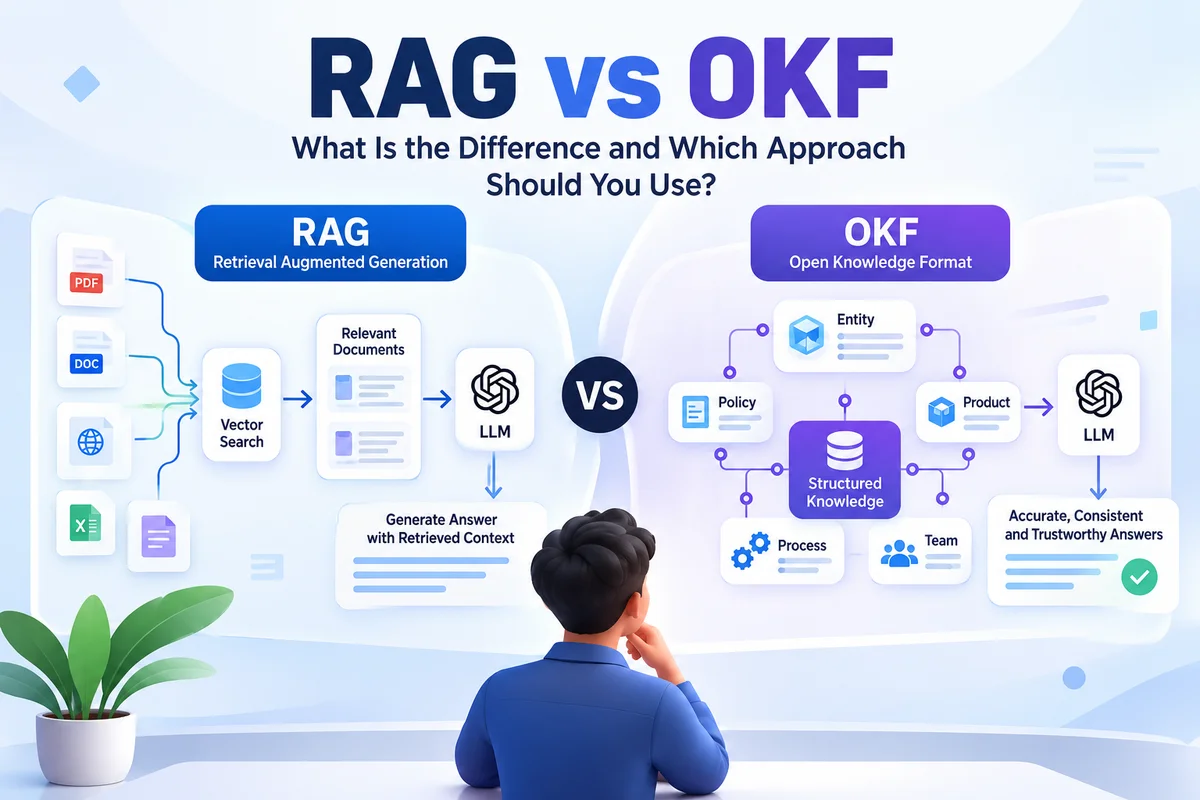
Retrieval-Augmented Generation means an application retrieves relevant information from an external source and then gives that information to a language model as context, rather than asking the model to answer only from what it learned during training. Roughly, a user asks a question, the system retrieves relevant documents, and the model generates an answer grounded in the retrieved material.
Imagine a company with twenty thousand internal documents. An employee asks about the refund policy for enterprise customers. The model does not inherently know this private information. A RAG system searches the company's knowledge base, retrieves relevant policy documents, and gives them to the model so it can answer using the available evidence. This makes RAG useful for private, frequently changing, or highly specialized information.
How a Typical RAG Pipeline Works
- Collect source material. PDFs, Word documents, websites, Markdown files, product catalogs, database records, technical documentation, support tickets, internal wikis, FAQs, policies, meeting notes, and knowledge-base articles become source material.
- Split documents into chunks. Long documents are divided into smaller sections. Small chunks can lose context when an idea spans several sections; large chunks can reduce retrieval precision and increase cost.
- Generate embeddings. Each chunk is converted into a numerical representation that captures semantic meaning. Similar questions can be recognized even when they use different words.
- Retrieve relevant information. The user's question is used to search for related chunks. Systems may combine vector similarity with keyword search, hybrid search, metadata filtering, reranking, or graph-based retrieval.
- Provide context to the model. Retrieved material is added to the user's question and system instructions. The model then generates a response using that combined context.
Why RAG Became Widely Used
A model's training data does not automatically include an organization's private or recently changed information. RAG can make that information available without retraining the entire model every time a source changes. It is useful for enterprise chatbots, support assistants, internal knowledge tools, documentation search, legal and technical research, product assistants, and many other applications where the answer must be found in a large collection.
Where RAG Falls Short
Adding a vector database does not automatically make an AI system knowledgeable. RAG quality depends on source quality, chunking, embeddings, retrieval strategy, metadata, filtering, reranking, context assembly, prompt design, freshness, duplicates, and conflicts between sources. If the system retrieves the wrong information, the model may still produce a confidently incorrect answer based on that context.
RAG retrieves information when a question is asked, but the underlying corpus may be poorly organized. That was the problem behind our inconsistent refund-policy answers: we had not established one canonical source of truth.
What OKF Actually Is
Open Knowledge Format (OKF) is a way to represent and package knowledge in a structured, portable, human-readable form. The format described in this article uses Markdown documents with YAML frontmatter and can include metadata about concepts, their status, provenance, lifecycle, and relationships.
OKF is not a vector database, language model, or retrieval engine. It does not replace those components. Its role is to help people and AI systems organize, describe, and maintain knowledge.
How OKF Works in Practice
An OKF knowledge bundle can be a collection of Markdown documents organized into folders by topic, such as products, policies, and technical documentation. It may include an index and a change log. Each concept document can have YAML metadata at the top—such as type, title, description, tags, and status—followed by the content itself. Documents can link to related concepts using ordinary Markdown links.
The important distinction from a typical uncurated RAG corpus is intent: knowledge is deliberately organized into distinct concepts instead of being treated only as a pool of text fragments waiting to be chunked.
The Core Difference Between RAG and OKF
RAG addresses the question: What information should be retrieved for this query?
OKF addresses a different question: How should knowledge be represented, organized, described, and maintained?
They are not direct competitors. RAG is primarily a retrieval-and-generation architecture; OKF is a knowledge representation and packaging format. They can work together in the same system.
RAG vs OKF: Side-by-Side Comparison
| Aspect | RAG | OKF |
|---|---|---|
| Full name | Retrieval-Augmented Generation | Open Knowledge Format |
| Primary purpose | Retrieve relevant information for a model | Represent and organize knowledge |
| Main layer | Retrieval and serving | Knowledge and content |
| Typical format | Documents, chunks, vectors, metadata | Markdown with YAML frontmatter |
| Vector database | Common, but not mandatory for every design | Not required |
| Human readability | Depends on source material and tooling | Designed to be human-readable |
| Version control | Depends on implementation | Works naturally with file-based version control |
| Relationships | Often inferred from retrieved content | Can be represented explicitly with links and metadata |
| Strong use case | Large or changing document collections | Curated, authoritative knowledge |
| Provenance and lifecycle | Depends on implementation | Can be represented through metadata |
| Retrieval engine included | Part of the broader RAG application architecture | No; OKF does not prescribe a query or serving engine |
| Can work with the other? | Yes | Yes |
The format does not, by itself, prescribe storage, serving, or query infrastructure. That is another reason it should not be treated as a direct substitute for a retrieval architecture.
RAG Thinks in Chunks
Imagine ten thousand documents processed into hundreds of thousands of chunks, embedded, and stored in a vector database. When a question arrives, the system finds relevant chunks and gives them to the model. This is effective when the answer is somewhere in a large, changing collection. For example, “Find incident reports from last year that mention database timeout errors” is naturally a search problem.
OKF Thinks in Concepts
Instead of treating every fragment as anonymous text, a curated knowledge base can organize information around concepts such as a customer, product, subscription, refund policy, enterprise plan, or support process. Each concept has its own document and can link to related concepts. An enterprise-plan document might link to pricing, subscription terms, refund policy, and support processes.
Those relationships become explicit parts of the knowledge structure rather than relying entirely on text similarity to reconstruct them for every question.
Why Explicit Relationships Matter
A company's definition of an “active customer” might depend on subscription status, payment status, cancellation date, and account status, with the details scattered across multiple documents. RAG can retrieve the relevant passages, but the model still has to determine how they fit together. A curated representation can document the definition and link it to subscription, billing, and cancellation rules.
This does not guarantee correctness. It makes the intended relationships easier to inspect, maintain, and use.
RAG Is Excellent for the Unknown
Consider hundreds of thousands of emails, support tickets, PDFs, meeting transcripts, and technical documents. It is impractical to manually create a maintained concept file for every item. RAG can index this material and make it searchable, which is valuable when nobody knows in advance where a particular answer will be found.
OKF Is Strong for the Known
Official product definitions, pricing rules, API specifications, business policies, data definitions, architecture decisions, operational runbooks, and compliance procedures are different. An organization may want to maintain these as authoritative references. Our refund policy belonged in this category instead of being reconstructed from scattered files.
Does OKF Eliminate the Need for RAG?
No. OKF does not remove the need to search large collections. A practical AI assistant may use curated company knowledge, customer conversations, support tickets, historical reports, external documents, and live systems at the same time.
A sensible architecture can route curated knowledge through an OKF-style knowledge layer and route broader, unstructured collections through RAG. Both can contribute context to the same response.
A Hybrid Architecture Worth Building
- Maintain important business concepts in a curated, reviewed, version-controlled knowledge layer.
- Use those files directly or index them for retrieval when that is useful.
- Use RAG to search the broader document collection that is not maintained as curated knowledge.
- Retrieve live information from APIs or databases when the question depends on current application state.
- Assemble the relevant evidence, preserve source attribution where possible, and pass it to the model to produce the answer.
This separates trusted organizational knowledge from the larger and messier searchable information environment.
Example: An AI Assistant for a SaaS Company
Curated knowledge might include product definitions, pricing rules, API documentation, company policies, and official workflows. A separate corpus might contain support tickets, customer conversations, email threads, historical incidents, and internal discussions.
- “What is our official cancellation policy?” Prioritize the curated policy.
- “Have customers reported this error before?” Search historical support data with RAG.
- “According to our official policy, how should we handle this customer's previous issue?” Use both the policy and relevant customer history.
The distinction becomes practical when each source has a clear role.
RAG Does Not Automatically Understand Business Meaning
A database may contain customer ID, subscription ID, status, creation date, and cancellation date. Retrieving documentation about those fields does not guarantee that a model knows the organization's exact definition of an active customer. That definition may depend on a specific combination of fields and business rules. It should be explicitly documented and governed rather than inferred from scattered mentions.
Knowledge Quality Matters as Much as Retrieval Quality
Imagine one document says enterprise customers can cancel at any time, another says they must give thirty days' notice, and a third clarifies that the notice period applies only to annual contracts. A retrieval system might find all three and still leave the model to reconcile their scope and authority.
This is a knowledge-quality problem as well as a retrieval problem. Structured, curated knowledge complements retrieval by documenting the authoritative rule, its scope, and its relationships.
When RAG Is the Right Fit
Use RAG when you need to:
- Search large collections containing thousands or millions of documents.
- Keep newly arriving information searchable through an indexing and update pipeline.
- Work with unstructured sources such as PDFs, email, tickets, articles, reports, and transcripts.
- Answer exploratory questions about historical incidents or prior conversations.
- Find long-tail information whose location is not known in advance.
When OKF Is Useful
Use an OKF-style structured knowledge layer when you need to:
- Maintain stable organizational knowledge, such as definitions, policies, architecture, runbooks, and product information.
- Let humans inspect and edit knowledge in readable files.
- Track changes using familiar version-control workflows.
- Keep knowledge portable across models, agent frameworks, and platforms.
- Represent relationships between concepts explicitly through links and metadata.
Vector Databases Are Still Useful
OKF does not make vector databases obsolete. Vector databases help search large collections using semantic similarity. OKF helps represent knowledge in a standardized, structured, portable form. OKF documents can be embedded and indexed in a vector database, then retrieved through a RAG pipeline. These technologies can be complementary parts of one architecture.
Knowledge Graphs Are Related but Different
A traditional knowledge graph represents entities and relationships in a graph structure—for example, a customer belongs to an organization, purchased a product, and has a subscription. OKF documents can link related concepts and support graph-like navigation, but an OKF bundle should not automatically be treated as a full enterprise knowledge graph platform. Their design goals and capabilities are different.
RAG vs OKF for AI Agents
AI agents may need to discover knowledge, follow relationships, use tools, read documentation, take actions, update information, and verify results. Structured, machine-readable knowledge can help agents navigate an environment more reliably. Regardless of format, agent-generated knowledge still needs appropriate review and governance before it is treated as authoritative.
Trust and Provenance Matter
An AI system should consider not only what a document says, but also where the information came from, when it was generated, whether it was verified, and whether it is still current. Metadata for provenance, status, lifecycle, and verification can help a system expose this context.
For example, a refund-policy answer is more useful when it can point to the approved source and its current version instead of merely repeating a passage retrieved from an arbitrary file. The exact provenance capabilities depend on the format version and implementation.
Which Should You Choose?
The question is not simply “RAG or OKF?” It is “What kind of knowledge problem are we solving?”
- Choose RAG when the core challenge is finding relevant information in a large or frequently changing corpus.
- Choose OKF when the core challenge is organizing and maintaining curated knowledge in a structured, portable way.
- Use both when you have authoritative knowledge alongside a much larger searchable collection.
- Add live APIs or database queries when the answer depends on current transactional or application data.
A Practical Decision Framework
1. How large is the knowledge base?
A small, focused collection may be manageable as structured files. Very large collections generally need search and retrieval infrastructure.
2. Is the knowledge curated?
Information deliberately defined and reviewed by people or a trusted process benefits from structured representation. Raw, scattered information is often easier to make accessible through RAG.
3. Do relationships matter?
If concepts depend on one another, explicit links and documented rules can help. If the task is to find a paragraph among millions of documents, retrieval may do most of the work.
4. How often does the knowledge change?
Both approaches need maintenance. RAG indexes must be synchronized with source changes; curated files and metadata must also be reviewed and updated. Neither approach eliminates data governance.
A More Complete AI Knowledge Architecture
A mature AI knowledge system rarely relies on one technology alone. A user's request can be routed to curated knowledge, a large searchable corpus, or live systems through APIs and databases. The relevant results are then assembled into context before the model generates an answer.
Different types of information need different access strategies. The architecture should reflect those differences instead of forcing every source through one pipeline.
RAG and OKF Work Better as Partners Than Rivals
OKF-style organization helps define and maintain trusted knowledge. RAG helps locate relevant information when a question arrives. Curated knowledge and raw documents can remain separate sources and converge in the same response pipeline. That makes the system easier to understand, govern, and maintain.
Mistakes to Avoid When Building RAG
- Indexing everything without cleaning it. Duplicates, obsolete documents, and contradictory policies can reduce answer quality.
- Ignoring metadata. Document type, department, version, date, product, access level, and status can improve filtering and retrieval.
- Using semantic similarity for every problem. Keyword search, structured queries, metadata filters, reranking, graph traversal, and business rules may also be needed.
- Treating retrieved text as unquestionable truth. Retrieved passages are evidence that must be evaluated for source, authority, and relevance.
- Forgetting maintenance. Documents, policies, products, APIs, schemas, and business rules change. Indexing and quality checks must evolve with them.
Mistakes to Avoid When Using OKF
- Putting everything into a few enormous files. Break knowledge into useful, navigable concepts.
- Skipping verification. An AI-generated document is not authoritative simply because it exists.
- Ignoring freshness. Well-structured knowledge can still become incorrect when the underlying information changes.
- Treating OKF as a search engine. A format is not a complete retrieval infrastructure. Large collections may still need indexing, search, and serving components.
Where AI Knowledge Systems Are Heading
The broader challenge is not only retrieving documents for a model. It is maintaining reliable knowledge that AI systems can use over time. This includes creation, verification, provenance, versioning, freshness, relationships, access control, retrieval, reasoning, agent interaction, and auditing.
RAG addresses an important part of this challenge. Structured knowledge formats address another. Neither alone covers the entire problem.
Final Comparison
RAG and OKF are not competing for the same role. RAG retrieves relevant information when a question is asked. OKF represents and maintains knowledge in a structured, portable form that humans and AI systems can work with. RAG is especially useful for large, dynamic, unstructured collections; OKF is useful for curated knowledge an organization wants to define and maintain.
For many real systems, the strongest approach combines curated knowledge, retrieval, live tools, and model reasoning. The system can then distinguish between information that should be explicitly maintained and information that must be discovered dynamically—the distinction that would have helped keep BytezBot's refund-policy answers consistent from the start.
Frequently Asked Questions
Is OKF replacing RAG?
No. They operate at different layers. OKF represents and organizes knowledge; RAG retrieves information for a model.
Does OKF require a vector database?
No. A knowledge bundle can use files and metadata without a vector database. A vector database may still be useful if you want semantic search over the content.
Can OKF and RAG be used together?
Yes. Structured knowledge files can serve as a source for a retrieval system, allowing curated knowledge and broader search to coexist.
Is RAG outdated because of OKF?
No. RAG remains useful for finding information in large, changing collections. OKF does not remove that need.
Is OKF limited to Google's products?
The goal of an open, vendor-neutral format is portability, but check the official specification and implementation details for the exact version you plan to adopt.
What company knowledge can be represented in OKF?
Examples include policies, product definitions, architecture documentation, workflows, operational runbooks, and API concepts.
Can an AI agent generate OKF documents?
Knowledge can be authored or generated by people, agents, or export pipelines, depending on the implementation. Review, provenance, and governance are still important before treating generated content as authoritative.
Should a small company use RAG or OKF?
It depends on the information. A large, frequently searched document collection points toward RAG. A smaller, carefully maintained knowledge base may benefit from structured files. Many organizations eventually use both.